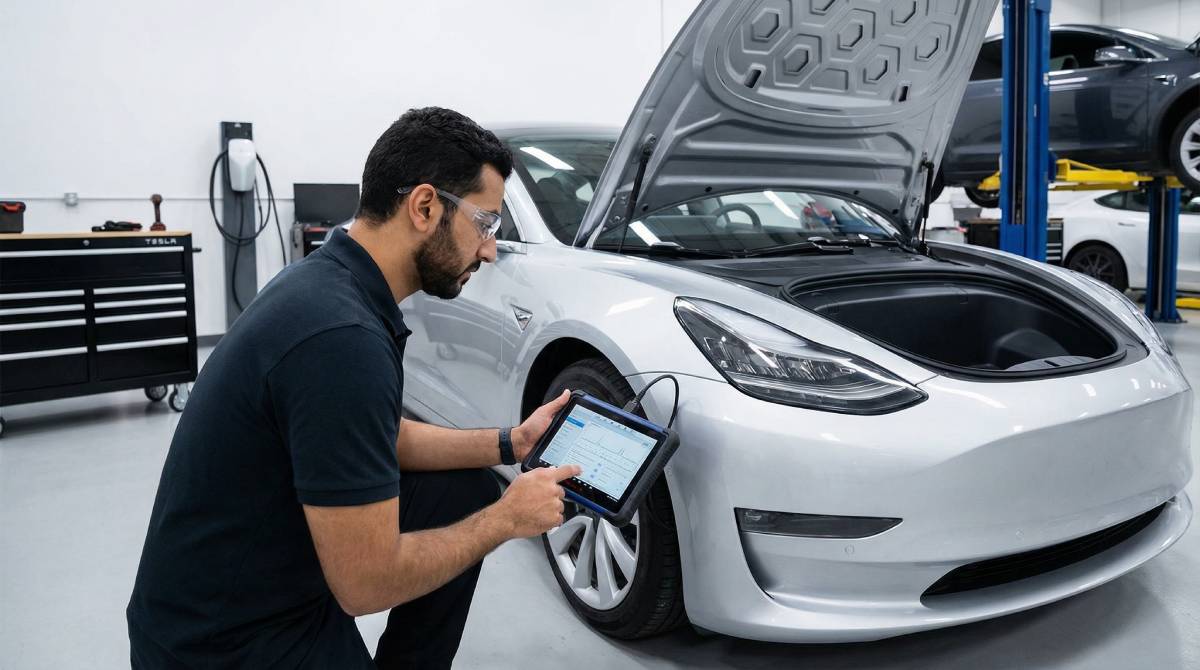
Electric vehicles (EVs) are known for being low-maintenance compared to petrol cars, but UAE owners face unique challenges. Blistering summer heat, fine desert sand, and urban traffic can all impact an EV’s performance and longevity. Maintaining your EV properly in the UAE’s climate is essential to ensure safety and reliability on the road. This expert guide, backed by industry insights, covers all you need to know – from caring for high-voltage batteries and tires to keeping cooling systems efficient – so you can confidently navigate EV ownership in the Emirates.
The UAE’s Climate: A Unique Challenge for EVs
The extreme weather and environment in the UAE demand special care for electric cars. High temperatures often exceed 40°C (even hitting 50°C in summer), which can stress EV batteries and systems. Desert sand and dust are constant factors – fine dust can infiltrate air filters and coat cooling components, potentially reducing efficiency if not addressed. And while EVs thrive in stop-and-go urban traffic (thanks to regenerative braking and no idling engine heat), the combination of heavy AC use in slow Dubai traffic and long highway runs through open desert can affect wear and tear. In fact, studies show that when ambient temperatures rise above 35°C, an EV’s driving range can drop by up to 15–20% due to the extra energy used for cooling. All these factors mean that UAE EV owners must be proactive and attentive in their maintenance routine.
Key maintenance areas for EVs include battery management, brake system checks, and tire care. Below, we’ll explore each of these – plus cooling systems, software updates, and local driving considerations – with an eye toward UAE-specific conditions.
Battery Care in Extreme Heat
Thermal management is the cornerstone of EV maintenance in the UAE. The lithium-ion battery pack is your EV’s most expensive and sensitive component, and our climate puts it to the test. High heat accelerates chemical reactions inside battery cells, which can shorten battery lifespan over time. Modern EVs do have advanced Battery Management Systems (BMS) and cooling loops to regulate temperature, but in our summers the system can be under constant strain. This can lead to slight range reductions as the car diverts energy to cooling the battery, or even slower fast-charging speeds on very hot days as a self-protection measure.
Best practices for battery care in the UAE:
- Park in the shade whenever possible: Avoid leaving your EV under direct desert sun for long periods. Prolonged heat soak can warm up the battery, especially if the car is not running cooling actively. Using shaded parking or garages can significantly reduce heat exposure. If shade is scarce, consider a reflective windshield sunshade or even a car cover for daytime parking.
- Charge during cooler hours: Try to schedule charging at night or early morning during summer. Charging itself generates heat in the battery, so doing it when ambient temperatures are lower reduces thermal stress. If you must charge in peak heat, your EV may automatically slow down fast charging to protect the battery. Also, unless you need maximum range, limit charging to around 80% on extremely hot days – this provides a safety buffer, as batteries heat up more when pushed to 100% charge.
- Monitor your state of charge and temperature: It’s not just about when you charge, but how much. Keeping the battery between ~20% and 80% charge for daily use is a widely recommended practice to extend battery life. Extreme highs and lows of charge put added strain on the cells, especially in heat. Most EVs let you monitor battery health and temperature via a smartphone app or the dashboard – use these tools. Many UAE EV drivers regularly check that their battery’s temperature is within normal range and that cooling fans or pumps are kicking in as needed.
- Don’t hesitate to use the AC (wisely): Cooling the cabin also cools the battery in many EV designs. In very high heat, pre-cool your car while it’s still plugged in if possible (many EVs offer a preconditioning feature). This means the grid power runs the AC before you start driving, bringing down both cabin and battery temps. Once on the road, use the AC as needed for comfort – just be aware it will draw power. Keeping the interior around 22–24°C is a reasonable balance for comfort without overly taxing the battery. Never leave occupants or pets in a parked EV without AC in UAE heat, and avoid leaving the car parked unventilated in direct sun with a full battery charge.
- Plan for range reduction: UAE EV models are often optimized for our climate, and manufacturers account for heat in their range estimates. However, you might still notice that a 45°C August day gives you a bit less range than a 25°C winter day. A well-maintained EV battery can handle our summers (many are tested for desert climates), but expect a temporary range drop of around 5–15% on very hot days due to AC usage and battery cooling. Plan charging stops accordingly on long trips – for example, if driving from Dubai to Abu Dhabi at noon, ensure you have a buffer of charge. It’s also wise to keep the battery at least 20–30% charged as a minimum; aside from protecting the battery, this gives the BMS enough power reserve to run cooling systems as needed.
Finally, follow manufacturer guidelines for battery coolant maintenance. Many EVs use liquid coolant to keep battery packs at safe temperatures. Over time (years), this coolant can degrade or get contaminated. Each automaker has its own schedule – for instance, Tesla recommends replacing the battery coolant every 4 years regardless of mileage, while a Chevy Bolt EV specifies a coolant change around 150,000 miles (240,000 km). Check your owner’s manual and adhere to those intervals. During your service visits, have technicians inspect coolant levels, pumps, and hoses for the battery cooling system. If you notice warnings about battery temperature, reduced performance in heat, or coolant leaks (puddles under the car), get the thermal management system checked immediately. As one UAE EV service specialist notes, in Dubai’s climate an unchecked cooling issue can quickly lead to battery overheating or “derating” (the car limiting power to protect itself) – proactive maintenance prevents that.
Tire Maintenance for EVs in the UAE
Your EV’s tires are literally where “the rubber meets the road,” and in the UAE those roads get extremely hot. EVs also tend to be heavier than comparable petrol cars (due to the battery weight) and deliver instant torque, which together can lead to faster tire wear if not managed. Proper tire care is critical for safety, efficiency, and longevity of your EV in this climate.
Key tire maintenance tips:
- Check tire pressure frequently (weekly if you can): Tire pressure can fluctuate with temperature – for roughly every 10°F (5.5°C) rise in ambient temperature, tire pressure increases by about 1 PSI. That means a tire inflated on a cool morning may be several PSI higher by midday. Overinflated tires reduce traction and can wear unevenly, while underinflated ones run hotter and drain battery range faster due to higher rolling resistance. In the UAE’s summer, it’s wise to check pressures often (when the tires are “cold,” i.e. before driving far) and set them to manufacturer-recommended PSI. Don’t forget to adjust for seasonal changes – a tire that was fine at 25°C in January might be overinflated at 45°C in July if not corrected. Keeping tires at optimal pressure can improve your EV’s range by 5–10%, according to reports by EV owners.
- Rotate your tires regularly: EV tires work hard. The combination of heavy vehicle weight and strong acceleration can cause rear tires to wear faster (on rear-wheel or AWD EVs) or even all tires to wear more on edges if alignment is off. Rotating tires every 5,000 to 8,000 km is generally recommended for EVs in our region. Regular rotation ensures even wear, which extends the life of the set and maintains good handling. Many EV service centers will rotate tires as part of routine maintenance – schedule it in, or at least have it checked at every service interval.
- Choose the right tires and inspect them often: If you need new tires, consider low rolling-resistance EV tires which are designed to handle EV loads and reduce energy loss. They also often have stronger sidewalls to cope with the weight. In the UAE, brands like Michelin, Bridgestone, and others offer EV-specific models that can improve efficiency and run cooler on hot roads. Whichever tires you use, inspect them frequently for cuts, punctures, or abnormal wear. The hot tarmac can be unforgiving – if you often drive on scorching highways or across construction areas, check for any embedded nails or damage. Also, sand and gravel can get lodged in tire treads; it’s a good practice to hose out or brush off heavy debris from the wheel wells and treads if you’ve been driving on sandy tracks, to prevent uneven wear or imbalance.
- Driving habits matter: How you drive greatly affects tire life, especially in summer. Rapid launches at every green light might be fun (EV torque is addictive!) but it will shred tire tread faster, especially when road temperatures are high enough to soften the rubber. Similarly, hard braking can create hot spots on tires. Try to drive smoothly – gradual acceleration and gentle braking not only extend tire life but also boost your range. Many EVs have an “Eco” or energy-saving mode which smooths out throttle response; using it during daily commuting or in heavy traffic can help modulate those sudden torque surges that eat tires. When cornering, take it easy on the roundabouts; fast, sharp turns at speed put a lot of lateral stress on tires (and can lead to sidewall damage in potholes). In short, treat your EV’s tires kindly and they’ll reward you with longer life and better efficiency.
- Don’t forget the basics: UAE law requires sufficient tread depth on tires (1.6 mm is the legal minimum, though for safe driving you’d want much more). Worn tires are downright dangerous on wet roads and can be more prone to blowouts in heat. Check tread depth – a simple way is the coin test or tread wear indicators on the tire. Also ensure your wheels are properly balanced and aligned; misalignment can cause rapid uneven wear. If you feel vibration or pull to one side, get an alignment check. Finally, remember to also inspect your spare tire (if your EV has one) or the tire repair kit condition, as many modern EVs come with repair kits instead of spares.
With well-maintained tires, your EV will handle better in the sand, grip confidently on hot asphalt, and roll efficiently – giving you a safer and more economical drive despite the harsh climate.
Brake System Checks and Maintenance
One of the interesting quirks of EV ownership is brake maintenance – EVs use regenerative braking, which means the electric motor slows the car and recovers energy, so the friction brakes (discs and pads) often get used much less than in a regular car. In city driving, you might hardly touch the brake pedal at all, since lifting off the accelerator engages regen braking. This dramatically reduces brake wear and is why EV brake pads can last far longer than those on petrol cars. However, “use it or lose it” applies here: if brakes sit idle too long, they can develop other issues like corrosion. UAE conditions add their own twist, with dust and occasional rain causing rust or grime on brake components. Thus, EV owners must not ignore brake maintenance – it just takes a slightly different approach.
Here’s what to keep in mind for EV brakes in the UAE:
- Regular brake inspections are a must: Even if your pads have tons of material left, have a technician inspect the brake system at least annually. In an EV, rust can be the enemy. Unlike an ICE vehicle where daily braking polishes off rust, EV brake rotors may develop a layer of rust from lack of use. Over time, that rust can pit the rotors or cause noise and reduced effectiveness when you do need the brakes. A service inspection will involve removing the wheels to check the pads and discs. They may clean off surface rust and lubricate caliper slide pins, ensuring everything moves freely. This kind of preventative maintenance is especially important in coastal UAE areas (salt in the air can accelerate corrosion) or if you park outside where overnight humidity can rust rotors.
- Use your brakes periodically: It sounds counterintuitive, but it’s healthy to exercise the friction brakes now and then. If your EV has adjustable regen (many allow selecting a low regen mode or have a feature to periodically dry the brakes), take advantage of that. Alternatively, every so often find a safe stretch of road and do a moderate brake application from a decent speed to knock off any rust. In fact, brake experts recommend an occasional brake burnishing – accelerating to about 80 km/h and then braking firmly (not ABS panic stop, but a good deceleration) down to 10–20 km/h, repeated a few times. This heats up the brakes and cleans the surfaces. Just ensure no one’s close behind you when you do this. It’s particularly a good idea after a rain shower or if you notice any grinding noises (often just rust being scraped off).
- Keep brake fluid on schedule: EVs use the same DOT3/4 brake fluid as other cars for the hydraulic brakes. That fluid absorbs moisture over time, which can corrode brake components and lower the boiling point. Even though an EV’s brake fluid isn’t boiling from heavy use (since regen does most of the work), it still degrades with time. Follow your manufacturer’s time-based schedule for brake fluid changes (commonly every 2–3 years). This will ensure your brake pedal stays firm and your brake system remains in good condition long-term. When servicing, make sure the shop properly bleeds the brakes – any air removed, and fresh fluid in.
- Mind the brake pads & rotors: Eventually, even with light use, pads may need changing – if not from wear, possibly from age or contamination. In dusty environments, brake calipers can get gunked up with fine sand and debris. Ask the service center to clean the calipers and pad slides periodically. Some EV manufacturers (like Tesla) actually issue maintenance advisories to clean and lubricate brake calipers annually, especially in regions with road salt or grime, to prevent the pads from seizing. If you hear squeaks or notice the car pulling when braking, don’t ignore it – even if the pads aren’t worn out, they might be sticking. UAE city driving with stop-and-go plus dust can create a layer of grit on pads; cleaning or lightly sanding the pad surface can restore quiet operation if done by a professional. And if pads or discs are worn or below spec, replace them. Replacement on EV brakes is infrequent, but when it’s time, use quality parts to ensure optimal regenerative/friction blending.
In summary, EV brakes in the UAE require a slightly different kind of attention: less frequent part replacements, but more vigilance against corrosion and dirt. By keeping them clean, lubed, and occasionally exercised, you’ll ensure that when you do need a sudden stop on Sheikh Zayed Road, your brakes bite strong and true.
Cooling Systems and Air Filters
Given our climate, the cooling system of an electric vehicle is truly its unsung hero. Unlike conventional cars, EVs don’t have an engine radiator in the traditional sense – but they often have multiple cooling circuits: for the battery, the motors, power electronics (inverter), and even the cabin AC. In many models, these systems are interconnected. For example, some EVs use the air-conditioning refrigerant to cool the battery, while others have dedicated liquid coolant loops. Keeping all these systems in top shape is critical for an EV to survive UAE heat.
Important maintenance points for EV cooling and filtration:
- Battery and power electronics cooling: As mentioned earlier under battery care, check and service the coolant system per manufacturer guidelines. A coolant flush and refill every few years can keep the thermal management working efficiently. But beyond the fluid itself, pay attention to cooling hardware. UAE workshops like to remind EV owners that pumps, valves, and cooling fans need to be inspected and occasionally replaced or repaired to maintain optimal cooling performance. If you ever see a warning related to battery temperature or reduced power in hot weather, it could indicate a cooling issue – e.g. a weak pump or a partially clogged radiator. Dubai’s frequent dust storms can blanket the front intake or radiator openings of a car with fine sand. Make it a habit to rinse the front grilles and radiator area gently when washing the car, especially after driving through a dusty area. Some EVs have front cooling air intakes that open and close (active grille shutters); ensure those aren’t jammed by debris. During servicing, ask for the battery cooling system to be checked: technicians can measure coolant flow, ensure the thermostat (if any) works, and verify that all fans kick on at the right temperature.
- Cabin AC system: The air-conditioning in an EV does double duty – it keeps passengers comfortable and in some cars helps cool the battery. Under the strain of 45°C outside temperatures, your AC works extremely hard. Regular AC servicing will pay off. This means checking refrigerant level and topping up if needed (fixing any leaks if found), and cleaning the condenser. The condenser in an EV is usually at the front (like a radiator) and can trap a lot of dust and bugs. A clogged condenser reduces cooling efficiency. Cleaning it (with compressed air or a careful wash) can improve AC performance. Also, listen for any unusual noises from the AC compressor; since it’s electric, it’s usually quiet – any loud mechanical noise could indicate it’s struggling. Keep an eye on AC performance: if you notice the air isn’t as cold as it used to be, get it checked before peak summer hits. Sometimes a simple refrigerant recharge and filter change makes a big difference.
- Cabin air filters: In the UAE’s sandy, dusty environment, cabin air filters get dirty fast. These filters clean the air that comes through your AC vents – trapping dust, pollen, even sand. Many EVs (Tesla, Nissan, etc.) have one or more cabin filters, and some are even high-efficiency (HEPA) types for better filtration. A dirty cabin filter can restrict airflow, making your AC work harder and reducing cooling. It can also lead to unpleasant odors or fine dust blowing into the cabin. Check your manual for the recommended interval, but in the UAE it’s often wise to replace cabin filters earlier than the standard schedule. For example, if the manual says every 15,000 km, you might do it every 10,000 km or at the start of each summer – because desert driving can clog it up quickly. It’s a quick and relatively cheap maintenance task. If you drive in frequent dust storms or off-road, consider upgrading to HEPA filters if available for your model; they can catch finer particles (some drivers note improved air quality, especially during dusty weather, with HEPA filters). And remember to use the recirculate mode on your AC when in heavy dust to minimize intake of outside air.
- Keep vents and sensors clean: EVs often have various temperature sensors – for battery, motors, cabin, etc. Ensure that any exterior temperature sensors or intake vents (like those at the base of the windshield for cabin air) aren’t blocked by sand or leaves. If you do a lot of desert driving, occasionally you might want to have a service center blow out the cooling ducts and check that no sand has accumulated in places it shouldn’t. Some owners who venture off-road even install additional mesh or filters on air intakes to catch sand – an extreme measure, but it shows how important dust prevention is.
In short, treat your EV’s cooling and air systems like the lifelines they are: flush fluids on time, keep everything clean, and fix any leaks or AC issues promptly. This not only prevents breakdowns but also ensures your EV runs efficiently – a well-cooled battery and drive unit operate more efficiently and maintain range better, even in brutal summer conditions. A little attention here goes a long way in the UAE’s climate.
Software Updates and Diagnostics
One maintenance aspect unique to electric vehicles (and modern cars in general) is software. Think of your EV as a “computer on wheels” – everything from battery management and motor control to charging and even braking is governed by software. Auto manufacturers continually refine their software to improve performance, fix bugs, and adapt to issues (including those related to climate and charging). Therefore, keeping your EV’s software up to date is an important part of maintenance.
Why software updates matter for your EV:
- Better battery management and efficiency: Software updates can improve how your car manages the battery, sometimes extending range or reducing degradation. For example, a software patch might tweak thermal management – perhaps running the cooling pump at a different threshold based on real-world hot-weather data – which could help the battery run cooler in UAE summers. Improved algorithms might also use the battery more efficiently. As one EV charging provider noted, updates often help your EV use its battery more efficiently, giving better range and longer battery life over time. Skipping those updates could mean missing out on optimization that’s especially helpful in our climate.
- Enhanced safety and reliability: EV software doesn’t just control driving; it also covers systems like regenerative braking, traction control, and charging safety. Regular updates can fix glitches that might, for instance, affect how regen braking behaves in stop-and-go Dubai traffic, or how the car interfaces with various public chargers. Just like your smartphone, EV software updates often include security patches too – protecting against potential cyber vulnerabilities in connected cars. While rare, these are important as cars become more connected (especially if you use apps and online features). Manufacturers also refine driver-assist features (like adaptive cruise or lane keep) via updates, making them more accurate which is a plus for safety on busy UAE highways.
- Fixing annoying bugs: Perhaps your infotainment screen occasionally freezes, or the navigation system reboots – these are the kinds of minor bugs that updates frequently resolve. Even issues with connectivity to certain charging stations or apps might be solved by a software update. It’s always good practice to apply updates that the manufacturer recommends, to keep everything running smoothly.
- New features and adaptations: One fun aspect of EV ownership is that sometimes an update brings new features – like an extra driving mode, better climate control logic, or new displays for energy usage. Over the air (OTA) updates can even improve performance in some cases. Tesla famously enabled extra range or altered suspension settings via software during certain events (like hurricanes). While not every EV gets dramatic changes, you might be surprised by small improvements. For example, an update could fine-tune the charging curve to make fast-charging a bit quicker in hot conditions, or add a timer feature for AC preconditioning on schedule – things that genuinely help in daily UAE use.
Bottom line: Don’t ignore those update notifications. Many EVs will alert you on the dashboard or smartphone app when a software update is available. Schedule it at your convenience (most require the car to be parked and not in use for a short period). Some cars do require visiting a service center for major updates, but most new models can do it OTA via Wi-Fi or cellular. Think of software updates as you would oil changes on an ICE car – essential periodic maintenance. As one expert put it, “Just like you wouldn’t skip an oil change in a gas car, don’t ignore software updates in your EV”. It keeps your car running its best and ensures you’re getting the most out of your vehicle’s capabilities.
Additionally, if your EV has remote diagnostics or mobile app monitoring, use these tools to your advantage. Many EVs can self-diagnose issues to a degree – they might alert you if the 12V battery is weak, or if a tire is low, or if there’s a fault in a motor or sensor. Pay attention to any warning lights or messages, even if the car seems to drive fine. Early detection via software can save you from a breakdown. For example, a warning about battery cooling performance might pop up before you actually notice a problem; that’s your cue to get it serviced. When in doubt, consult with a professional (or your EV’s customer support) if you see any software warnings or strange behavior.
Local Driving Conditions: City Traffic vs. Desert Roads
The UAE offers a mix of driving environments – from dense urban traffic in Dubai and Abu Dhabi to long open highways through desert landscapes. These conditions can affect your EV in different ways, and it’s wise to adapt your maintenance and driving habits accordingly.
Urban stop-and-go traffic: In city driving, your EV actually has some advantages. Low-speed, stop-and-go conditions allow regenerative braking to shine – every time you lift off the accelerator, you reclaim energy and reduce wear on your friction brakes. However, heavy traffic often means prolonged use of air-conditioning while idling at lights or crawling along, which can strain your battery on hot days. To mitigate this, keep your cabin as cool as needed but not freezing; set a reasonable temperature and use features like seat ventilation (if available) to stay comfortable without maxing out the AC compressor continuously. Also, note that frequent short trips (school runs, quick errands) can limit the battery from reaching optimal operating temperature or might not give regen a chance to fully recharge the battery between stops. There’s not too much to worry about here, but if your daily use is all short trips, consider occasionally taking the car on a longer drive to “exercise” the battery and systems – a run on the highway can help balance battery cells and burn off any brake rust. In traffic, be mindful of your 12V auxiliary battery as well (the small battery that runs accessories); EVs charge the 12V off the main battery, but if you sit parked in ACC mode a lot (using lights, AC, music without driving), you could drain the 12V. Regular service will check the health of this 12V battery too.
Long-distance and highway driving: EVs cruising at 120-140 km/h on the E11 or other highways face a different set of stresses. High speed increases aerodynamic drag, which means your energy consumption per km goes up (you might notice your range drop faster at 130 km/h than at 100 km/h). This isn’t a maintenance issue per se, but plan charging stops accordingly. More pertinent is the heat: sustained high-speed running in 45°C weather generates a lot of heat in the motors and battery. Make sure your cooling systems are tip-top (as discussed) and consider slightly moderating your speed in extreme heat if you’re encountering any thermal limitations (some EVs will actually limit power if the battery gets too warm). Also, check your tires before long highway trips – ensure pressures are correct (fill in the morning before it gets hot) and tread is good, as a high-speed blowout is very dangerous.
For those planning desert or off-road excursions (e.g. venturing to the desert camps, farms, or off the beaten path): remember that deep sand driving in an EV can be tricky – the constant wheel spin can overheat motors and consume charge very fast. While few will take a typical EV dune bashing, even gravel or sand tracks to remote locations require caution. Reduce tire pressure appropriately (and carry a portable inflator to pump back up when you return to paved road). Know that traction control software will work hard in loose sand; some EVs have “Sand” modes – use them if available. Always have ample charge before going off-road, as range can plummet in such conditions. After such trips, do a thorough cleaning: sand can accumulate around brakes, suspension, and cooling intakes. Rinse the undercarriage and wheel wells. Clean or replace cabin filters if you drove through a sandstorm or very dusty area; they can clog quickly. It’s also wise to have your wheel alignment checked if you did any significant off-roading or hit potholes, since rough terrain can knock things out of alignment (leading to uneven tire wear).
In summary, adapt your driving and maintenance to the scenario: city driving is gentle on mechanicals but heavy on AC; highway driving is smooth but heats things up; desert conditions demand preparation and post-trip cleanup. By anticipating the effects of each, you can prevent excessive wear. For example, a commuter who mostly drives in urban Dubai might focus on tire rotations (due to many turns and stops) and cabin filter changes (due to pollution and dust), whereas someone frequently driving Abu Dhabi to Dubai might be more vigilant about coolant temperature and tire condition at high speeds. Recognizing these patterns is part of expert vehicle care.
UAE Charging Infrastructure and RTA Support
One of the bright sides of owning an EV in the UAE is the rapidly growing support infrastructure and pro-EV policies. Knowing how to leverage these can make maintenance and ownership easier. Here are some local considerations:
- Widespread charging network: The UAE, especially Dubai and Abu Dhabi, has invested heavily in EV charging stations. As of 2023, there were roughly 2,000 public charging stations across the UAE, with the majority in Dubai. This number includes a mix of AC chargers (slower) and DC fast chargers, and it’s steadily increasing. Dubai’s utility (DEWA) runs the “Green Charger” network, and other players like ADNOC, Tesla, and private providers also operate stations. Why is this relevant to maintenance? It means you should rarely need to overly stress your battery by “deep cycling” it – with chargers readily available, you can top-up more frequently and avoid running the battery down to near-zero. Also, the availability of fast charging means if your EV’s battery or charging system ever shows signs of trouble (e.g. not charging as fast as it should), you can compare at multiple stations to rule out charger issues. Tip: Use apps like DEWA’s EV app or PlugShare to locate nearby chargers, and incorporate charging stops into long trips for battery health. It’s better to do two shorter fast-charges with cooling breaks in between than to push the battery in one ultra-long stretch in extreme heat.
- Integration with RTA services: In Dubai, when you register a new EV, the RTA and DEWA have a digital integration that automatically creates an EV charging account for you. This means you’ll quickly receive a DEWA Green Charger card or account login, enabling you to use public chargers with ease. Take advantage of this by registering and keeping your charging accounts active – DEWA’s rates for charging are much cheaper than petrol per km, and having an account also often grants you perks like discounted (or previously even free) charging promotions.
- RTA incentives and regulations: The government has offered several incentives to encourage EV adoption. Dubai’s RTA has provided free Salik tags upon EV registration (note: toll fees themselves are not waived, but the tag is free) and designated free parking spots for EVs in many areas. For instance, you’ll find green-painted EV parking (often with charging stations) at malls and public parking buildings – RTA allows EVs to park free in these green zones for a certain time limit, which is a nice perk. Make use of these benefits – they not only save money but also signal that your car is an electric vehicle (which can be helpful if you ever need assistance or access to certain areas). Abu Dhabi and other emirates have had similar incentives like free registration or inspection fee waivers at times. These policies evolve, so keep an ear out for announcements (RTA apps or social media often update them).
- Annual vehicle inspections: All UAE vehicles must pass annual inspections for registration renewal, and EVs are no exception. The difference is EVs don’t undergo emissions testing (one of the big benefits – no more tailpipe tests). Instead, the inspection for an EV will focus on brakes, lights, suspension – the standard safety items – and may include some EV-specific checks. In fact, Dubai’s inspection centers have specialized protocols for EVs: they will verify the battery’s safety and mounting, check the charging port operation, inspect high-voltage cables for insulation damage, and even confirm that your EV is running the latest software/firmware for safety reasons. They might also test that regenerative braking functions properly on the roller dynamometer test. One important tip: go to the annual inspection with your EV charged to at least 50%. If the battery is too low, they might not be able to perform certain tests (and in worst case, a low battery could cause a fail or a delay). Keeping your car well-maintained – brakes effective, no burnt-out bulbs, tires in good shape – will ensure you pass on the first go. If you have any custom modifications or repairs on the high-voltage system, it’s wise to get a professional check before inspection day.
- Professional service centers: While on the topic of support, note that UAE now has multiple specialized EV service centers (beyond the dealer network). For example, Swedish Experts, EVS, and EV Hub are independent workshops equipped to handle electric cars. These shops have trained technicians and the right tools (like high-voltage safety equipment and diagnostic software) to maintain and repair EVs. This is great for owners once the vehicle is out of warranty or for getting a second opinion. When choosing a service center, ensure they follow proper safety protocols for HV systems and have access to genuine or high-quality parts. The good news is, as EV popularity grows, so do the expertise and options for servicing them in our region. Don’t hesitate to seek out an expert if you encounter any issue outside of routine maintenance – EV drivetrains are sophisticated, but a trained specialist can often diagnose problems quickly using computer diagnostics.
By staying informed about local infrastructure and regulations, you’ll not only keep your EV running smoothly but also enjoy the full benefits of owning an electric car in the UAE. From easy charging to VIP parking spots, the ecosystem is increasingly in your favor.
Professional Care for Peace of Mind
Electric vehicles are more than capable of thriving in the UAE – as long as owners give them the proper care. By focusing on battery health, tire and brake upkeep, cooling system efficiency, and software updates, you can ensure your EV runs optimally despite the heat and sand. Always pay attention to what your car is telling you – unusual noises, warning lights, or performance changes – and address them early. With the UAE’s strong charging infrastructure and supportive policies, owning an EV here is becoming ever more convenient.
While many maintenance tasks are straightforward, it’s always wise to have expert eyes on your vehicle periodically. Call to action: Consider scheduling a professional EV inspection or service with Swedish Experts. Our certified technicians have extensive experience with electric vehicles and understand UAE-specific conditions inside out. We can perform comprehensive battery and thermal system checks, tire rotations, brake servicing, and software diagnostics to keep your EV in peak condition. Don’t leave your EV’s health to chance – book a maintenance appointment with Swedish Experts and drive with confidence that your electric car is ready to conquer the UAE’s roads, whether in summer heat or city streets.
By following the best practices outlined in this guide and partnering with the right service professionals, you’ll enjoy all the benefits of electric driving in the Emirates – high performance, low running costs, and the satisfaction of contributing to a greener future – with none of the worries. Happy (and safe) electric motoring!
Co-owner of Swedish Experts — dedicated to precision, safety, and excellence in chassis repair.
Off-duty — passionate cyclist and carp fishing enthusiast. Believes success in both business and hobbies requires strategy and patience.