Introduction: Ever wondered how auto body experts can restore a bent vehicle frame back to perfect factory condition? The answer often lies in advanced systems like Car-O-Liner, a world-renowned frame repair technology. Car-O-Liner is a computerized chassis alignment and measuring system that takes the guesswork out of collision repairs. In this article, we’ll explain what Car-O-Liner is, how it works, and why it matters – especially for vehicle owners and fleet operators in the UAE. You’ll learn about the high-tech components (benches, measuring arms, Vision2 software, targets, sensors) that make this system so precise, the benefits over old-school methods, and how it keeps your car safe and roadworthy in a region with strict standards.
What Is Car-O-Liner? A Global Leader in Frame Repair Technology
Car-O-Liner is a leading brand of collision repair equipment known worldwide for its quality and innovation. Originating over 50 years ago in Sweden, Car-O-Liner today is used in more than 70 countries. The company’s alignment and straightening systems have set industry standards for accuracy and efficiency. In fact, tens of thousands of Car-O-Liner systems are in use globally, and many automakers trust or certify these systems for repairing their vehicles. (For example, certain Car-O-Liner frame racks meet OEM approvals – some even carry BMW and Mercedes-Benz certification for use in authorized repairs.) In short, Car-O-Liner has a global reputation for helping collision centers restore vehicles to factory specifications with pinpoint precision and reliability.
How Does the Car-O-Liner System Work?
Car-O-Liner’s frame repair system combines a heavy-duty alignment bench with computerized 3D measuring tools and software guidance. Here’s a simplified look at how it works and its key components:
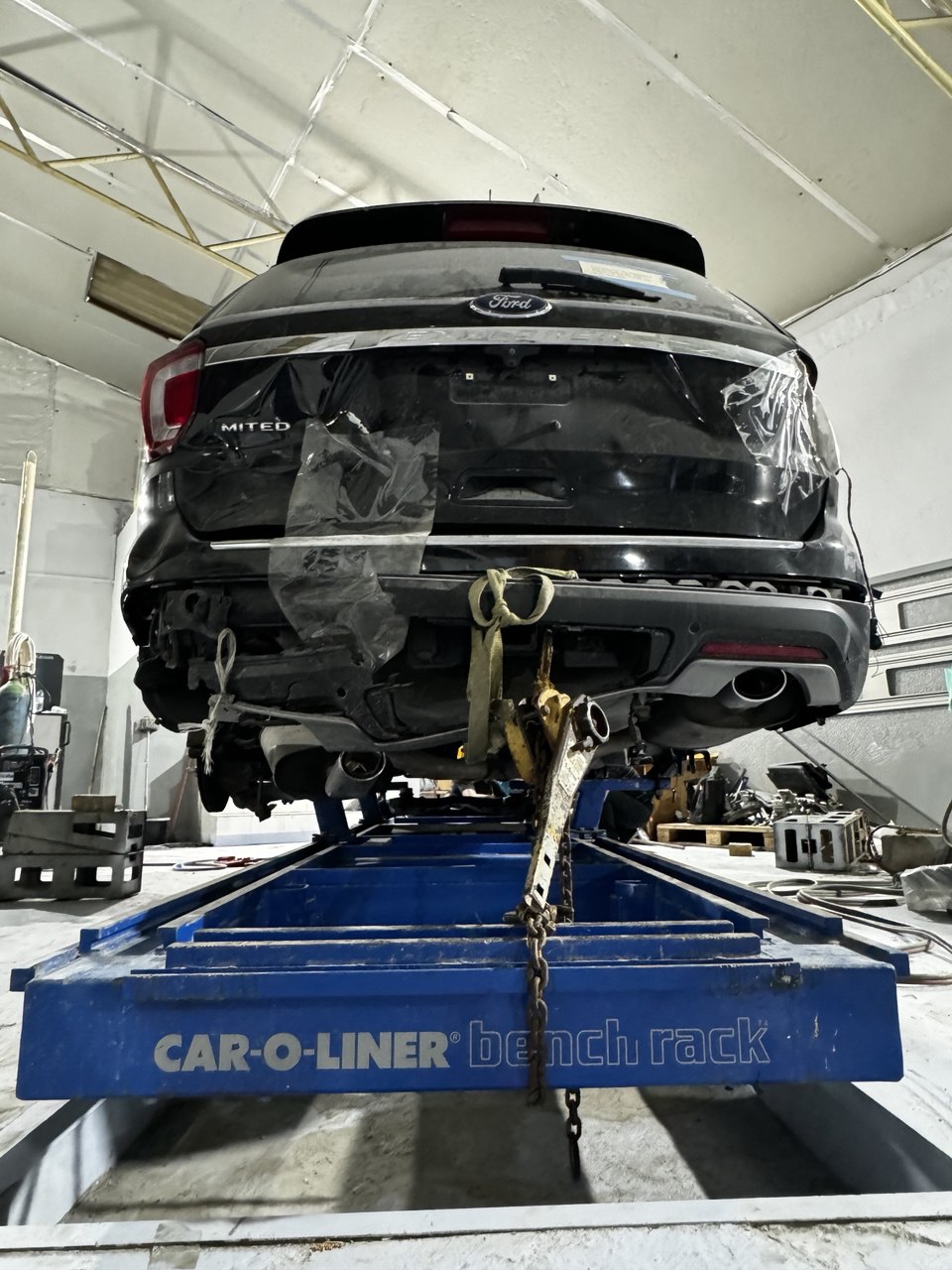
- Frame Alignment Bench: The vehicle is secured on a robust platform (such as Car-O-Liner’s BenchRack) using clamps and supports. This bench can lift the car and provides 360° access for repairs. It also integrates hydraulic draw aligners (towers) that can pull or push the frame with up to 10 tons of force from virtually any angle. By anchoring the car to this level platform, technicians have a solid “fixed base” to measure and straighten the chassis as needed.
- Electronic Measuring Arm (Car-O-Tronic): Car-O-Liner’s trademark measuring device is a sensor-equipped arm (often called the measuring slide) that attaches to the bench and the vehicle’s reference points. It can freely move around and under the car, reading the position of special measuring adaptors or targets placed at key chassis points. This arm uses multiple sensors (with no external lasers needed) to track its position in three dimensions. It even has a built-in remote control and LED indicators to guide the operator to each measuring point. The measuring arm wirelessly transmits real-time data – up to three times per second – to the computer software.
- Vision2™ Software and Car-O-Data™: The brain of the system is Car-O-Liner’s Vision2 software, which runs on a computer. Vision2 receives the live measurements from the arm and compares them against the vehicle’s correct dimensions stored in the Car-O-Data database. (Car-O-Data is an enormous vehicle measurement database with specs for over 18,000 car and truck models.) The software provides a 3D graphical display of the car’s frame, showing any areas that are out of alignment. It’s photo-guided and user-friendly, helping technicians identify the exact factory reference points and see deviations in millimeters. Essentially, Vision2 acts as a digital map that highlights where the chassis is bent or twisted by comparing measured points to factory specs in real time.
- Targets and Sensors: Depending on the specific Car-O-Liner setup, technicians either attach precision targets/reflectors at specified chassis points or directly hook the measuring arm’s probe to those points. In either case, the system knows exactly where each point should be if the frame is straight. As the arm “touches” or reads each target, the sensors capture its XYZ position. Green/red LED lights on the arm often indicate when you’ve reached the correct spot, and the software logs the measurement. This process is repeated at multiple strategic locations (both underbody and upper body points like suspension mounts, body mount locations, etc.) to assess the entire structure.
- Hydraulic Straightening Equipment: Once the measurement phase identifies any misalignment, the heavy lifting begins. The Car-O-Liner bench is equipped with hydraulic rams/towers and chains that can be affixed to the vehicle’s frame or pulling clamps. Technicians follow the software’s guidance and use these towers to apply controlled force to the bent areas of the frame. For example, if the front frame rail is pushed 2 cm to the left, the system will direct a pull from the appropriate angle to bring it back in line. The bench’s towers can pull from almost any angle around the car, and an optional second tower can even double the pulling power for tough jobs. During pulling, continuous measurements are taken – the Vision2 software updates in real time to show how the frame is moving and when it reaches the correct position. This iterative pulling and measuring continues until all points are within the manufacturer’s specified tolerances.
- Computerized Accuracy: The hallmark of Car-O-Liner is precision. The system can detect structural misalignments down to very small tolerances (often within a millimeter). Unlike manual measurement methods, the computer will immediately flag even subtle bends or twists that aren’t visible to the naked eye. This means nothing is left to guesswork – technicians get an exact diagnosis of the chassis. And after the straightening is done, the system can print a detailed before-and-after report showing all measurements, proving that the vehicle’s frame is back to factory specs. Many customers feel reassured when they see these measurement printouts confirming their car’s frame is straight within millimeters – it’s scientific proof that the repair was successful.
In summary, Car-O-Liner’s process is measure → analyze → straighten → verify. The combination of a sturdy bench, sensor-guided measuring arm, and intelligent software creates a closed-loop system. It first diagnoses the frame damage with digital accuracy, then physically corrects the structure while continually measuring to avoid any errors or over-corrections. This is a huge leap from older, manual methods, which we’ll discuss next.
Step-by-Step: Frame Diagnosis and Straightening with Car-O-Liner
To put it all together, let’s walk through a typical frame repair sequence using Car-O-Liner technology:
- Vehicle Setup: The damaged vehicle is driven or winched onto the Car-O-Liner bench. Technicians secure it using clamps at the wheels or chassis points, anchoring the car firmly to the platform. The bench is then raised to a comfortable working height (it acts like a lift) and, if needed, tilted for easier access.
- Initial Measurement: Using the Car-O-Liner measuring arm and adaptors, the technician attaches measurement points under the car (and sometimes on upper body points). The Vision2 software is loaded with the vehicle’s make/model data from Car-O-Data. The measuring arm is then moved point-to-point under the car, and the system records the chassis dimensions. This step reveals any deviations by comparing current measurements to the factory blueprint. For example, the readout might show the left front frame horn is 10 mm lower and 5 mm shifted compared to spec – a clear sign of collision damage.
- Analysis and Plan: With the full measurement report, the software highlights all misaligned areas in a 3D image. The technician now knows exactly which parts of the frame are bent and in what direction. Using this information (often alongside automaker repair guidelines), they plan the pulling strategy – deciding where to attach the bench’s hydraulic tower and what direction/amount of force to apply. This plan ensures targeted correction of damaged areas without unnecessary teardown of undamaged sections.
- Frame Straightening: The hydraulic draw aligner tower is set up on the bench at the needed angle (these towers slide along the bench rails and can rotate around the car). Chains or clamps from the tower are affixed to the bent section of the frame. The technician activates the hydraulic pump to slowly pull the frame. This is done carefully and incrementally – applying controlled force to gently bend the metal back. During each pull, the Car-O-Liner measuring arm stays attached and monitors the movement in real time. The software shows the misalignment reducing (e.g. that frame horn moving closer into spec as the pull progresses). The technician stops pulling once the measurement indicates the section is back in the correct position.
- Verification and Adjustments: After the major pulls, a full set of measurements is taken again. If some points are still slightly off, additional adjustments are made. Car-O-Liner’s feedback loop allows multiple small corrections rather than one big guess – ensuring the structure isn’t over-straightened or distorted elsewhere. In some cases, parts of the frame might be so damaged that they require cutting out and welding new sections (or reinforcements) in. Car-O-Liner benches often have fixture systems (like the EVO kits) to hold new parts in exact alignment during such replacements. After any part replacement or welding, the measuring system is used again to check alignment.
- Final Measurement Report: Once all chassis points fall within the manufacturer’s specifications, the repair is considered complete. The final measurements are documented. Technicians can generate a printout or digital report from the Vision2 software showing the vehicle’s frame dimensions before and after repair. This report typically indicates any deviations in millimeters and confirms everything has been corrected to OEM standards. It serves as proof for the customer (and for insurance or regulatory bodies if needed) that the vehicle’s “skeleton” is straight and sound.
Throughout this process, Car-O-Liner acts as a precise guide. It essentially “coaches” the technician through the repair, from identifying damage to confirming the fix. This step-by-step approach ensures nothing is overlooked, which is crucial for the vehicle’s safety and performance down the line.
Benefits of Using Car-O-Liner Technology
Using Car-O-Liner for chassis inspection and repair offers numerous benefits over traditional methods. Here are some key advantages:
- Precision and Accuracy: The system provides laser-level accuracy (figuratively speaking, since Car-O-Liner’s electronic measuring doesn’t even require separate lasers) in diagnosing frame issues. It can detect misalignments invisible to the eye and measure in full 3D, ensuring the chassis is returned to exact factory dimensions. This precision means your vehicle will drive and protect you as it was designed to, with no lingering structural flaws.
- Efficiency and Time Savings: Car-O-Liner’s computer guidance speeds up the repair process. Technicians don’t waste time on trial-and-error pulls or repeated disassembly. The Vision2 software shows exactly where the problem is and when it’s fixed, so repairs can be done right the first time. Additionally, the bench’s design (drive-on ramps, hydraulic lift, 360° access) makes it faster to set up and work on a car. Overall, shops using Car-O-Liner can straighten frames significantly faster than with older equipment, meaning less downtime for vehicle owners and fleet operators.
- Safety and Quality of Repair: By following the Car-O-Liner measurements, technicians ensure the frame is structurally sound and all crumple zones, suspension points, and body mountings are in the correct place. This is vital for safety – even small misalignments can affect how a car handles or how airbags deploy in a crash. Car-O-Liner essentially guarantees OEM-quality repair. Many vehicle manufacturers trust these systems for approved collision repairs, which speaks to the quality level achieved. When your vehicle is repaired on a Car-O-Liner, you can be confident it’s as safe and stable as before the accident.
- Documentation and Transparency: The ability to produce a detailed measurement report is a big benefit for owners. You get a transparent record that the frame is straight. This can be extremely useful for insurance claims or future resale. For example, if you ever need to prove that collision damage was properly repaired, the Car-O-Liner printout is hard evidence. In the UAE, some insurance companies even ask for a chassis alignment certificate after major repairs, to confirm the car is roadworthy. With Car-O-Liner, meeting that requirement is straightforward – the system’s report shows the chassis is within specs.
- Reduced Secondary Damage & Tear-down: Because the system pinpoints exactly what’s bent, technicians only fix what’s actually damaged. There’s no need to cut or hammer parts that are perfectly fine. This targeted approach preserves the integrity of the rest of the vehicle. It also often means less dismantling of the vehicle. In many cases, Car-O-Liner measurements can be taken with the car mostly intact (no need to remove all body panels), which saves labor and reduces the chance of causing any new issues during disassembly or reassembly.
- Modern, Ergonomic Design: Car-O-Liner equipment is designed with user-friendliness in mind. The software is visual and easy to learn, and the measuring arm has helpful features (like LED guidance and remote control operation) that simplify the technician’s job. The ergonomic bench height and tilt improve worker safety and comfort. All this means fewer errors and a smoother repair process, which ultimately benefits the vehicle owner through a better repair outcome.
In short, Car-O-Liner brings speed, accuracy, and confidence to frame repairs. It marries cutting-edge tech with practical, rugged machinery, resulting in a better repair for your car and peace of mind for you as the owner.
Car-O-Liner vs. Traditional Manual Methods
To appreciate Car-O-Liner’s significance, it’s worth comparing it to how frame straightening was done in the past. Older manual methods for frame repair were far more labor-intensive and less precise:
- Measurement by Tape and Eye: Traditionally, mechanics would use tape measures, plumb lines, and basic tram gauges to check frame dimensions. They might measure diagonals between chassis points manually to infer if the frame was “square.” This left a lot of room for error – human eyesight and measuring tape can only be so accurate. In contrast, Car-O-Liner’s digital system reads coordinates in 3D with computerized precision, eliminating guesswork.
- Trial-and-Error Pulling: Before computer guidance, straightening a frame often involved attaching chains and hydraulic jacks to a frame rack and pulling based on experience or rough measurements. Technicians would pull a bit, measure again manually, and adjust repeatedly. It was easy to over-pull or mis-pull, sometimes even causing new damage. With Car-O-Liner, the entire pull is monitored in real time on screen, so the tech knows exactly when to stop. This controlled process prevents the “yo-yo” of pull-measure-pull that characterized older methods.
- Limited Reference Data: In the past, shops relied on paper manuals or charts for each vehicle’s frame dimensions (if they had them at all). Finding the right reference points and ensuring the car matched those specs was cumbersome. Car-O-Liner’s Car-O-Data library puts an enormous range of vehicle specs at the technician’s fingertips instantly. Photo-based diagrams show where to place measuring adapters, and software auto-selects the right points, making it much easier and more reliable than flipping through manuals.
- Labor and Time: A manual frame alignment could take significantly longer and often required multiple technicians. With an automated system like Car-O-Liner, one skilled technician with the system can do the work more efficiently. The reduction in labor and time is beneficial not only for the repair shop’s productivity but also for owners who get their vehicles back sooner.
- Verification Challenges: Perhaps the biggest drawback of older methods was the lack of a clear verification. After a manual repair, you had to trust the technician’s word or do a basic road test to guess if the car was straight. There was no detailed printout or easy way to prove alignment. Car-O-Liner changed that by providing a measurable, repeatable verification – if the computer shows all points green/in tolerance, you know the frame is right. This level of certainty was hard to achieve with manual means.
In summary, traditional frame straightening was as much an art as a science, heavily dependent on the technician’s skill. Car-O-Liner turned it into a science-backed process. It leverages computerized measurement to bring a new level of accuracy and consistency that older methods simply can’t match. This doesn’t just make the technician’s job easier – it results in a safer, better-aligned vehicle for you.
Why Precise Frame Repair Matters (Accidents, Resale & Insurance)
Accident Repairs & Safety: After a collision, repairing the frame isn’t just about making the car look good again – it’s about making it safe. The frame (or chassis) is the backbone of the vehicle, and all the crash protection features (crumple zones, airbags timing, etc.) assume the frame is straight and strong. If a bent frame is not fully corrected, even a minor future accident could have catastrophic results because the vehicle’s structure won’t respond as designed. By using Car-O-Liner to restore your chassis, repairers ensure your car can properly absorb impacts and protect the occupants as it did originally. Steering, suspension and braking also rely on a true frame; misalignment can cause pulling, uneven tire wear, and unpredictable handling. Thus, precise frame repair is essential for your safety and your vehicle’s performance after an accident.
Resale Value: In the used car market, a history of frame damage can seriously hurt a vehicle’s value – but proof of a proper repair can mitigate that. Many buyers in the UAE (and elsewhere) are wary of cars that have had structural repairs unless they see evidence that the work was done correctly. A Car-O-Liner measurement report or chassis inspection certificate showing the frame is back to spec can boost buyer confidence and resale value. It demonstrates transparency: you’re upfront that the car had damage, but you have official data that it was fixed to factory standards. Without such proof, buyers might assume the worst, and as some experts note, an unrepaired or poorly documented bent chassis can make a car nearly unsellable (in extreme cases, the car’s value might drop to a fraction of its pre-accident worth). For fleet operators rotating out vehicles, having documentation of frame repairs and inspections can also improve the remarketing value, since it signals the vehicles were well-maintained. In short, investing in high-quality frame repairs pays off by protecting your vehicle’s value.
Insurance Considerations: Insurance companies care a lot about structural repairs because it affects the car’s future risk. If your car’s frame is fixed properly, it’s less likely to fail in a subsequent accident. Some insurers in the UAE actually require a Chassis Alignment/Measurement Certificate (often produced by systems like Car-O-Liner) before they will restore full coverage on a repaired vehicle. This is to ensure they’re not insuring a structurally unsound car. A Car-O-Liner printout showing your chassis met specs after repairs can be critical evidence. It can support your claim that the car is safe to drive again, helping avoid disputes with insurers. Additionally, if there’s ever a question about pre-existing damage or repair quality, that measurement report is hard proof of the car’s structural state at that time. Thus, precise frame repair and documentation can smooth out insurance claims and give you the paperwork you need to keep your vehicle fully insured.
Supporting UAE’s Strict Standards and Modern Fleets
In the UAE, maintaining vehicle safety is taken very seriously. The authorities have strict inspection standards to ensure every car on the road is roadworthy, especially when it comes to structural integrity. For example, if a car has been in a major accident, it often must undergo a specialized chassis measurement test (CCM – Computerized Chassis Measurement) at an authorized center before it can be re-registered. Notably, Dubai’s Roads and Transport Authority (RTA) uses Car-O-Liner’s exact same computerized measuring technology for its official chassis inspections. This underscores how trusted and accurate the Car-O-Liner system is – it’s effectively the gold standard that even regulators rely on to decide if a car’s frame is within allowable limits.
For vehicle owners and fleet managers in the UAE, this technology is a huge asset. Here’s why Car-O-Liner is especially relevant in the UAE context:
- Strict Roadworthiness Requirements: Because UAE regulations require vehicles to be structurally sound for registration, using Car-O-Liner helps ensure you’ll pass those inspections. If your car’s frame is repaired with Car-O-Liner, you’ll have the measurements and reports to prove it meets the official standards. This saves you from potential headaches, like failed inspection tests or costly rework, when renewing your registration.
- Safety on Highways: The UAE’s highways see high speeds and heavy traffic, so any weakness in a vehicle’s chassis can be dangerous. Modern fleets (taxis, delivery vans, buses, etc.) operate daily under these conditions. Car-O-Liner technology allows fleet operators to keep their vehicles’ frames in top shape, catching and correcting structural issues proactively. This not only keeps drivers and passengers safe but also prevents small alignment issues from turning into bigger problems down the line.
- Modern Vehicles, Modern Repairs: The UAE has a very modern vehicle fleet – many cars are high-end models with advanced construction (lightweight alloys, complex crumple zones, etc.). These vehicles demand advanced repair techniques. A traditional hammer-and-chain approach simply won’t suffice for, say, an aluminum Audi chassis or a high-precision SUV frame. Car-O-Liner provides the sophistication needed to repair such vehicles correctly. It supports both unibody cars and body-on-frame 4x4s, covering everything from luxury sedans to commercial trucks. In a region where people invest in quality vehicles, it makes sense to use a quality repair system to fix them.
- Peace of Mind for Owners: UAE drivers are often very discerning and safety-conscious. Knowing that your accident-damaged car was repaired with a Car-O-Liner system can give you peace of mind. It means the repair shop didn’t cut corners – they used top-tier equipment to ensure your vehicle’s structure is sound. This peace of mind is invaluable whether you’re driving your family or operating a business fleet.
- Supporting Fleet Reliability: For fleet operators (delivery companies, ride-share services, corporate fleets), vehicle downtime and accidents can significantly impact operations. Car-O-Liner’s efficiency can speed up repairs, getting vehicles back on the road faster. Moreover, by maintaining structural integrity, it helps avoid future issues like uneven tire wear or alignment problems that could sideline a vehicle later. In a place like the UAE, where logistics and transport are key, keeping a fleet reliably on the move is a competitive advantage – and high-quality repairs play a part in that.
In summary, Car-O-Liner technology aligns perfectly with the UAE’s focus on vehicle safety and modern standards. It’s not about legal compliance per se (so we won’t dive into law details), but about helping local drivers and companies keep their vehicles safe and roadworthy. The combination of precision, efficiency, and documentation means you can confidently drive a repaired car, knowing it meets the bar set by both the manufacturer and the local authorities.
Conclusion
Car-O-Liner frame repair technology represents the cutting edge of collision repair – a fusion of strong engineering and smart software. For vehicle owners and fleet operators, understanding this system is valuable. It means when the unfortunate happens (a collision or chassis damage), you know there’s a proven method to bring your vehicle back to its original safety and performance. Instead of worrying if a garage will “pull the frame straight enough,” you can look for workshops that use Car-O-Liner or similar CCM systems, and be assured that the repair will be done with millimeter accuracy.
In the UAE, where safety standards are high and vehicles are an important investment, Car-O-Liner provides an extra layer of confidence. It helps ensure that after repair, your car or truck isn’t just almost right – it’s exactly right. From the initial computerized measurement to the final printout, everything is documented and precise. This level of care keeps our roads safer, preserves the value of vehicles, and gives everyone from individual owners to fleet managers peace of mind.
In essence, Car-O-Liner takes frame repair from the realm of art into the realm of science. It’s a great example of technology making a difficult job easier and more accurate. So, the next time you hear about a car’s frame being straightened, remember that with systems like Car-O-Liner, it’s not brute force and guesswork – it’s a carefully guided process that ensures your vehicle’s backbone is as straight and strong as the day it left the factory. Your safety rides on it, and Car-O-Liner delivers.
Co-owner of Swedish Experts — dedicated to precision, safety, and excellence in chassis repair.
Off-duty — passionate cyclist and carp fishing enthusiast. Believes success in both business and hobbies requires strategy and patience.