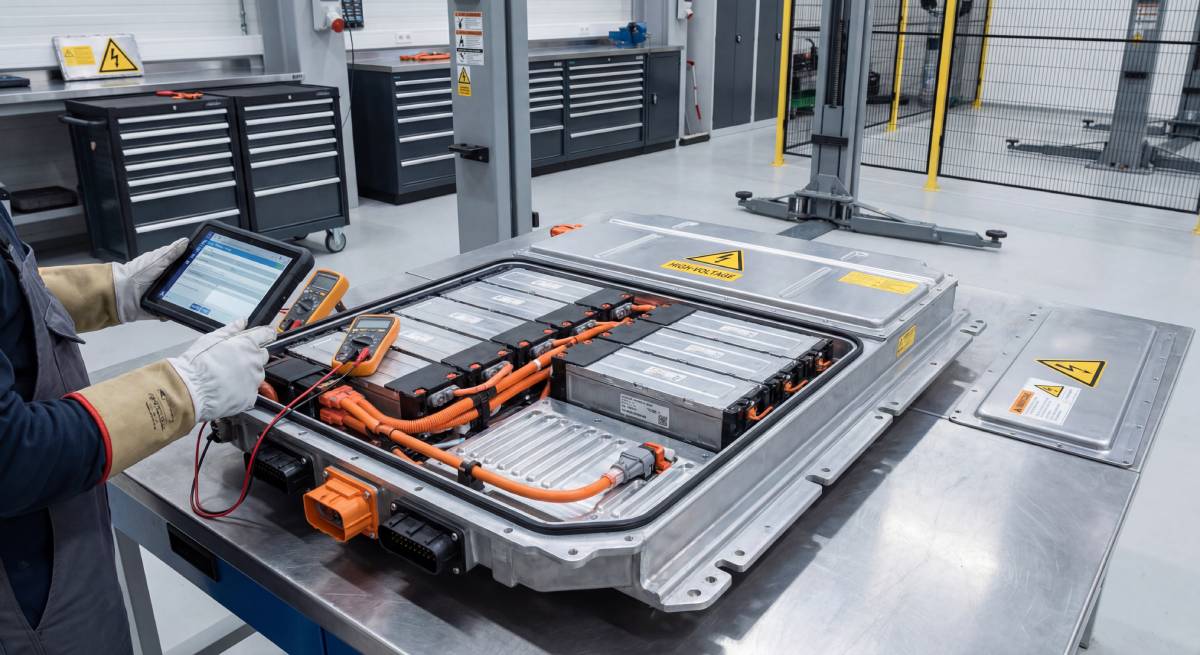
This guide explains what hybrid and EV battery repair is, the most common symptoms of battery failure, how to diagnose high-voltage battery issues, and what repair or replacement methods exist. It includes safety notes, cost factors, repair options such as module replacement and cell balancing, and signs when the vehicle should not be driven.
Use this summary to understand when a hybrid or EV battery requires professional diagnostics and what steps drivers should take to extend battery life.
EV and hybrid car owners experiencing reduced range or performance
Drivers with warning lights or battery overheating
Owners of vehicles with high mileage or declining battery State of Health
Anyone researching repair vs replacement options for EV or hybrid batteries
What Is Hybrid Battery Repair?
Hybrid and EV battery repair includes diagnostics, cell balancing, module replacement, high-voltage (HV) system testing, thermal management inspection, and restoring the battery pack’s performance without full replacement.
Most modern EVs and hybrids (Toyota, Lexus, Honda, Nissan, BMW, Mercedes, Tesla, etc.) use lithium-ion or NiMH battery packs made of many individual modules. When several modules degrade or fail, the pack loses capacity — but in many cases it can be repaired, not replaced.
Symptoms of a Failing Hybrid or EV Battery
Most common signs include:
Reduced driving range
Rapid charge drop (e.g., 60% → 20% in minutes)
Battery overheating during driving or charging
Lower acceleration / weaker electric motor assist
Increased fuel consumption in hybrids
Warning lights: EV System, HV Battery, Check Hybrid System
Vehicle enters limp mode
Uneven module voltages
Slow or interrupted charging
Fans working louder than usual
If 2+ symptoms appear — diagnostics is required.
Common Causes of Hybrid / EV Battery Problems
Mechanical & Wear-Related
Natural cell degradation
High mileage usage
Manufacturing defects
Corrosion in bus bars and connectors
Environmental
Constant exposure to heat
Bad cooling system / faulty thermal management
Humidity causing electrical oxidation
Electrical
Battery module imbalance
HV relays or contactor failure
Bad voltage sensor
Faulty BMS (Battery Management System)
Usage Factors
Regular deep discharges
Fast-charging cycles (EVs)
Long-term parking with low charge
How to Diagnose Hybrid & EV Battery Issues
Battery diagnostics includes several steps:
HV Safety Preparation
Only trained technicians should work with HV batteries: